Detroit Retail Market Sees Stronger Demand as Investment Falls
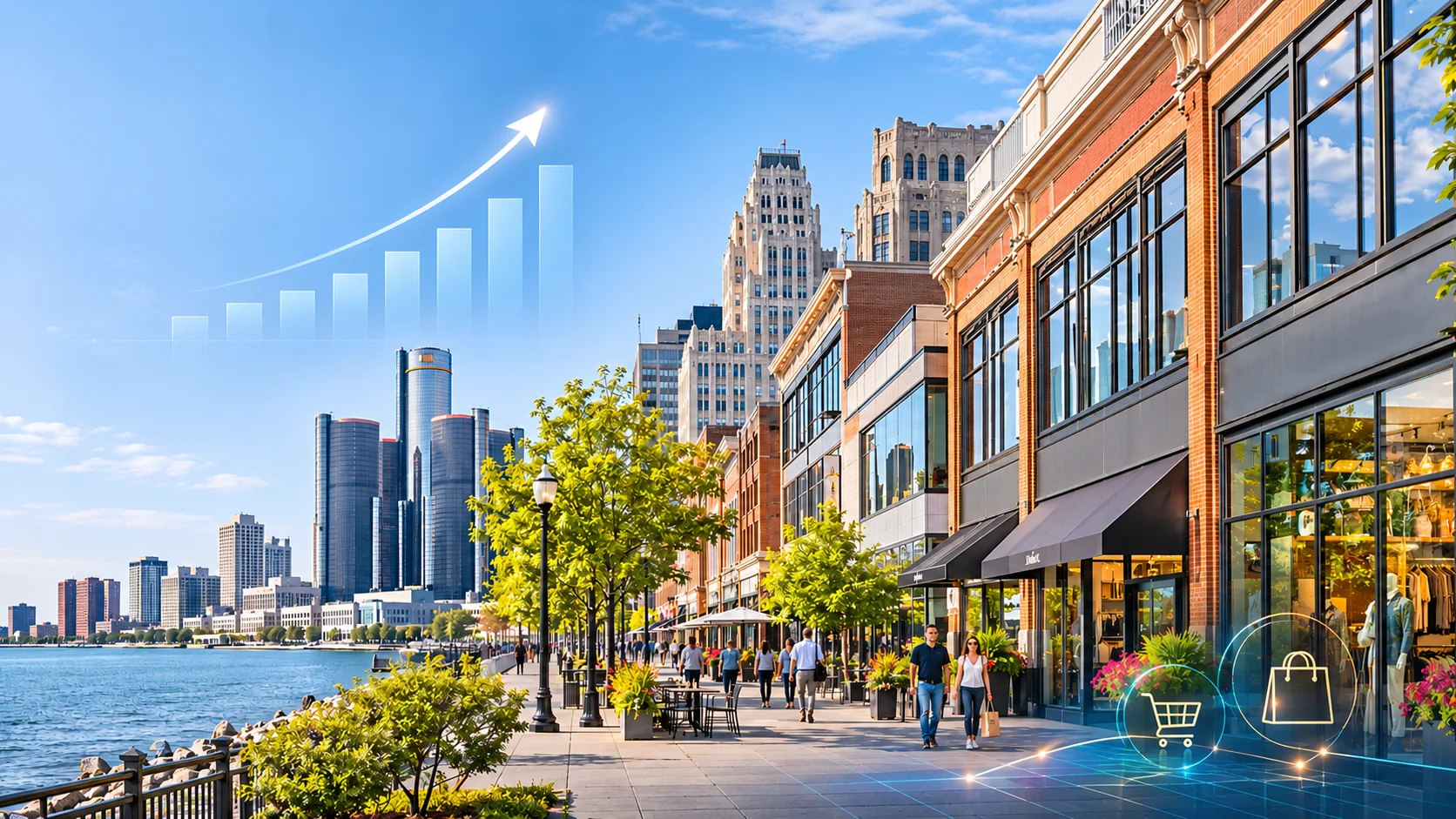
Detroit's retail market recorded stronger demand in the third quarter of 2026, with vacancy declining and rental growth gaining pace. However, retail investment activity slowed, as sales volume dropped compared with both the previous quarter and the same period last year.
The metro recorded approximately 2 million square feet of retail net absorption over the trailing 12 months, ranking third nationally. Dallas-Fort Worth led with 4.2 million square feet, followed by Phoenix with 3 million square feet.
Quarterly net absorption reached 990,390 square feet through September, marking a significant turnaround from the second quarter, when the market recorded 221,522 square feet of net occupancy losses. The latest figure was also 29.1 percent higher than the 767,433 square feet absorbed during the third quarter of 2025.
Trailing 12-month absorption increased 14.3 percent from June, when it stood at nearly 1.8 million square feet. The improvement was particularly notable against September 2025, when Detroit recorded 509,864 square feet of net occupancy losses.
Retail Vacancy Declines as Rents Increase
Retail vacancy in Detroit fell to 4.8 percent in the third quarter, down 30 basis points from June and 60 basis points from a year earlier. The market's total retail inventory reached nearly 264 million square feet, adding approximately 147,000 square feet during the quarter and 371,000 square feet over the year.
Annual market rent growth also picked up, reaching 1.7 percent through September. This compared with 0.4 percent through June and 1.5 percent during the corresponding period last year. Despite the change in growth rates, market rents remained around $19 per square foot across all three periods.
Redevelopment plans along Detroit's waterfront could also bring additional opportunities for retailers. Dan Gilbert pledged $1 billion towards establishing a nonprofit organisation to redevelop the Renaissance Center and East Riverfront area. The proposed 35-acre district includes space for Detroit-based small businesses, affordable housing and 18 acres of public space.
Retail Investment Sales Lose Momentum
Despite stronger leasing activity, Detroit's retail investment market experienced a considerable slowdown. Transaction volume reached $88 million in the third quarter, down 31.7 percent from $128.9 million in the previous quarter. Compared with the $241.6 million recorded a year earlier, sales volume declined 63.6 percent.
Transaction pricing moved in the opposite direction. The average price reached $153 per square foot, increasing 19.5 percent from $128 in the second quarter and 13.3 percent from $135 a year earlier. Changes in the types of properties sold during each period may have contributed to the higher pricing.
The figures point to contrasting trends in Detroit's retail sector, with occupancy demand improving even as investment transactions lose momentum.